Showing posts with label photography. Show all posts

Thursday, July 30, 2015

All the Things I Do Not See

As much as I try to compose my photographs before I take them, I never see everything that's in the frame. Sometimes I shoot too quickly when breezes threaten to jiggle a perfectly lit petal or just as I'm about to squeeze the shutter release, two other photographers walk right into the edge of the shot.  Thanks to digital cameras, I can review the images I just took and catch most of the more blatant blunders.  
However, I firmly believe that the invisible garden imps almost always add a little something just before I upload my day's work to the computer.  Then the nasty little buggers wait for me to start post-processing and have a laugh. Did I take that? When? I didn't take that! Why didn't I see that leaf, person, tree, humungous bee?  What's that stick coming out of Ingmar's head?  Did a bird poop on that David Austin Rosa ‘Ausleap’ Sweet Juliet?  When?  You get the idea.

At least I've made progress. Four years ago, this horse photo gave me a lot of experience in corrective post-processing. Along with other, minor problems, there was a big honkin' fence running across the lower third of the horse. It didn't look rural or vintage. It just looked bad. And it took FOREVER to get rid of while leaving all the horse bits and each bloody blade of grass intact. I learned a lot from that and gained a lot of skill. And when I had the chance to have a sort of well-known photographer give me feedback on my work, of course I included that shot.                   
He said it was nice (oh no, kill me now), he said it had a romantic feel to it, and then he asked, "What's that big wooden bench-like thing on the horse's back?"  Huh? Where? Damn. I looked at every inch of that photograph for HOURS.  How did I miss that?   What IS that? "You've got to look at your images more carefully," was what he said. Yup.

Today I was outside with my macro lens taking pictures, hoping for some bloggy inspiration. One patch of Echinacea was doing well, so I set up a tripod and started shooting. Bright, cheery, colorful, blah. Finally, I changed my angle and tried for a dive into the center of just one specimen. I was concentrating so hard on getting all those little florets in the head of the flower in focus that I didn't look at what else was going on, figuring I'd just crop out everything else. However, the imps  had other ideas.
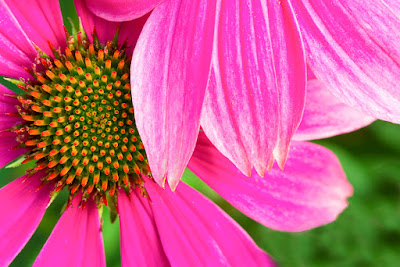
The only shot with the inflorescence in semi-decent focus had petals from a neighboring Coneflower flopping over a third of it.  When did THAT happen?  Did I want to spend an hour trying to clone out those petals and clone the florets back in?  Not really.  I was just about to head outside to reposition and reshoot, when it hit me:  I like this image.  It's a lot more interesting than the one I'd planned.  Well OK then!

 I also spent time experimenting with these Astilbe chinensis. Unlike their feathery cousins that come up in spring, these nubbly ones really get going by mid-summer. I wanted to emphasize the nubbles, but wasn't having a lot of success. They're pretty and look like what they are, but something was missing.  Not that I had a clue what that was.

Once more the imps had their way with me.  When did I take this shot?  Was I standing above the plant, shooting downwards?  Is this a side-on view that needs to be rotated? 
Maybe, but I like it better this way.  It looks like some sort of deep-sea creature, one of those blind ones that swims close to the bottom of the ocean in the dark.  It also expresses what I like best about these Astilbes.

The most common post-processing surprises are insects.  Unless it flies and is a butterfly or has a stinger, I'm just not seeing it.  Here's a Scabiosa, and, as a photograph, what can you say?  Pretty flower, maybe, but I wanted more.
 Then something caught my eye--most of you probably already saw it--so I cropped in to take a better look.
What IS this green-glowing critter?  I really would like to know, by the way.  And getting in this close, I got to share just a tiny bit of his experience of the flower, fall into another world entirely.  Also,  the common name, "Pincushion Flower" makes a lot more sense to me now.  Post-processing surprises can sometimes be the very best sort.  And, yes, my personal imps don't always mean to ruin my day.


Thursday, July 23, 2015

Unexpected Garden Glamour: Runway Monardas

I am fickle when it comes to plants. One year it was Polemoniums, the next Astilbes, then Pieris, and Penstemons.  I shopped for them as though I'd just discovered a rare beauty and needed to populate my gardens with my new obsessions before the world caught on.  But soon I'd tire of my favorites and find my eye wandering to a newer cultivar, a more appealing hue, a plant with a truer sense of style.

It never occurred to me that the feathery, bee-laden Monardas happily populating the sunnier patches of my landscape were the stuff of Haute Horticouture.  Too common. Too artless. Too friendly.
 But then I noticed the dynamic pose struck by this young Bee Balm.  One leaf gestures with confidence, arrow-head straight, while the other is gently rounded, pointing earthwards.  The red, tubular flowers reveal themselves gradually, with just the suggestion of a double emerging from its crown.  How could I have missed this!?


Not long after, this other specimen took center stage, and could hardly be more alluring.  Here was a more mature sense of self-possession, knowing how much (or how little) to reveal.  How much stem to show in order to balance out the sly tilt of the double (veiled by the artfully veined sepals).  She even knew which way to turn for the most flattering light.  My admiration knew no bounds.

However, all this flash and attitude has its limits.  I was beginning to ache for a quieter, more subtle expression.  And, on the other side of my propane tank, I found the soft beauty I was looking for.


Monarda didyma 'Blaustrumpf'

These two charming 'Blaustrumpf's glowed with an innocent yet powerful grace.  They drew me to the shade, to the subtlety of flat, even light, to a more natural look.  No artifice here.  A pose without posing.  Naked existence as elegance.  With the tank providing a nice, neutral backdrop, I'd even discovered a new approach to domestic landscape photography:  
Industrial Chic for the Garden


Alas, I find I have a limited tolerance for youth's scrubbed, pretty face and admit to a weakness for the more theatrical side of nature.  (And the propane guy had just arrived to fill the tank).  So this jester's hat of a Bee Balm bloom brought me back into the sun.  No secrets here, just the generous eruption of scarlet petals in a sea of unfocused green.


But I am no shallow photographer.  I can appreciate the wisdom, complexity, and, yes, the prickly peace of age.  This Monarda seedhead has one last red petal hanging on as a reminder of earlier days--a week or so before.  What remains is Nature's ultimate sculpture, the repository of future generations.  Too soon powdery mildew will leave my once buoyant models beyond  even Photoshop's rejuvenative skills.  And, once again, I am left to haunt the nurseries for fresh faces and new inspirations. 

Thursday, July 9, 2015

Go For the Blur

  Photographers can get obsessed with sharpness and with good reason.  Eyes, in my experience, seem to want to concentrate on what takes the least amount of work. Staring at something that's blurry is tiring.  So eyes will search for a focal point (like autofocus in a camera), moving around the visual field, pulling in and out until they can achieve that place where seeing is effortless and the subject is clear.  No matter the depth of field (the distance between the closest and furthest objects that remain in focus), having the thing you want viewers to gravitate to completely in focus makes sense. Also, sharp photos just look nice.

It's definitely easier to get a subject in focus if that subject holds still.  Here's a picture of Bailey (note the shallow depth-of-field--cat eyes and nose sharp while flowers and cat body not so much).  He is not holding still for me; I believe he is focusing elsewhere, like on a vole or a bug.  So he is holding still so as not to scare off his potential prey.  No matter; he stopped moving long enough for me to take a sharp photo.

However, I mostly shoot pictures of plants, and shouting "stop moving" doesn't really work all that well (it doesn't work on cats either). So a crucial problem anyone who likes to shoot plants has is that they have a tendency to respond quite quickly to their immediate environment.  And as much as I enjoy breathing, air makes my job a lot harder. It just takes a whiff for my subject to shimmy. And all the tripods and remote shutter releases in the world won't help. If I can't use a fast shutter speed, I've got to sacrifice the depth of field I want, and if I up the ISO I'll have to deal with noise (sorry for the tech-speak--just trust me; it's a thing). This means I spend a lot of time waiting for the breezes to subside, which is pleasant, I admit. But it can get frustrating too.

Bellingham has been having a very unusual heat wave. And here in my little microclimate from hell, it's been oven-hot. NOT what I moved north from Los Angeles for. So standing outside in a breeze this morning was heaven . . . and then, not so much because I was trying to photograph flowers on stalks. No polite flutters and then the calm. These suckers just wave around like they're hailing a cab in a crowd after an Everly Brothers Reunion concert. After a lot of waiting, fidgeting, resetting settings, and more waiting, I decided toss my plans to the winds, use a slow shutter speed, and see what the blurs would look like.


Here's a Veronica spicata 'Ulster Blue Dwarf', also known as Speedwell.  No wind.  Sharp(ish) focus on the closest stalk.


Now, here comes the wind.  Yes, the focused one was taken earlier in the season, but let's not quibble. 

  This is what is known as "blur."  If you move your eyes back and forth, from the sharp one to the blurry one and back really quickly, the blurry one will start to look more like painting.  Or like a blurry photo.
OK.  Let's try again.  Below is a photo of another Veronica spicata but now a 'Giles van Hees'.
 And here comes the wind:

At this point I'm going to provide some information to distract you.  I did not know that Veronica wasn't the  common name, but the genus.  Although no one seems willing to go on record as being certain, most of the sources I consulted agreed that the name was probably associated with the Veronica who it was said gave Jesus her veil to wipe his forehead on his way to Calvary.  When he returned it, the cloth supposedly bore his likeness: vera icon = true image.  As for naming the plant after her or the cloth, that becomes a little less clear (yes, pun/reference intended here to show that this IS all connected to my topic).  Some sources say that the likeness on the veil resembled the flowers of the plant.  Sharp or blurry, I just don't quite see it.  Now the common name--Speedwell--makes a bit more sense.  As an medicinal herb, it is purported to have several healing qualities--much like an Christian icon might have for some believers.

So what I have taken away from my little experiment:  While some blurs can work artistically or can be used to convey a sense of motion, I think I'd rather wait out most breezes and attempt to catch the moment when my Speedwell holds still. 

Thursday, June 25, 2015

Benched: Rethinking Gardens, Photography, and Blogging

Bodnant Garden, North Wales


It's been nine months since my last blog post, and I confess (couldn't resist, sorry) that I didn't think I'd be coming back. But after reading some posts about the Toronto Garden Bloggers' Fling and especially about the talk Gayla Trail gave about resisting/rejecting the urge to make money and/or accrue followers, I felt the urge to rethink my approach. 

Garden Path at Snowshill Manor in The Cotswolds
Bodnant Garden
 Add to that the fact that I've been riding the photography roller-coaster known as microstock since January. This is the field where you get micro-pay for taking technically perfect (at the friggin' pixel level) photos of stuff other people might want to use to illustrate [fill in blank]. 


While I learned a lot and improved a lot, I found myself taking way too many shots of gravel, tree bark, doors, and hands planting flowers with lots of space to the left or right. I also spent too much time staring at noise, pixels, and things I had no names for and couldn't see at reasonable sizes.
Even my flower portraits were reduced to colored squares and fuzzy stuff. There were few real ideas and no love.  And I was rejecting shots that didn't fit the microstock commercial mold or meet the technical requirements.  But what about my requirements?  They receded--as did I--further and further into the background.

The Glades, Surrey, Canada
Maybe I'm approaching this all wrong. There are just too many people with too many cameras to "compete." Anyone can take a picture. Mine aren't the best or the worst, and the somewhere in between is too broad and varied a field to even begin discussing. But I still like to take pictures of things I like looking at.
I garden. Not well, not often enough for public display. But I like looking at plants and digging around in the dirt.  I enjoy growing things, and when I end up killing some of the things I tried to grow, I enjoy learning about why they died.
I can put words together better than some but not enough words or often enough.

So I have some skills, and I have some activities I sometimes let myself enjoy.  And I still have a blog--at least I still have the name and the space.

So I'm going to find a nice bench in a garden, sit awhile, and think my own thoughts.  And enjoy the view.

Hidcote Manor Garden, Gloucestershire